
Education
Dartmouth College, Class of 2028
B.A. Computer Science & Mathematics (Double Major)
Hanover, New Hampshire // AIT Budapest Fall 2026
Part I
College Courses
Mathematics
- MATH 8Calculus of Functions of One and Several Variables
- MATH 13Calculus of Vector-Valued Functions
- MATH 22Linear Algebra with Applications
- MATH 07.04Analyzing Network Data †
- MATH 70Elements of Multivariate Statistics & Statistical Learning
- MATH 60Probability (Honors)
- MATH 30.04Evolutionary Game Theory and Applications
Computer Science
We studied mathematical foundations of inference, learning theory, supervised and unsupervised machine learning, statistical inference, prediction, and data mining. There were topics I’d encountered in scattered pieces through research. Logistic regression, SVMs, PCA, expectation maximization, Gaussian mixtures, decision trees, k-means, naive Bayes, k-nearest neighbors surfaced as a specific answer to a general question about structure in data, which made the relationships between them (and their failure modes) legible.
Final project: a semantic analysis model predicting Amazon star ratings from review text. GitHub
Received a Citation for Meritorious Performance.
The class was about learning how to solve computational problems that show up across different fields. We studied abstraction (how to hide details), modularity (how to decompose problems), data structures (how to efficiently organize data), and algorithms (procedures for solving problems).
Webcam Painting via Region Growing
Built a real-time webcam painting app that tracks a color using flood-fill region growing. Given a target color, it runs BFS over pixel neighborhoods (8-adjacency), grouping connected pixels within a color-distance threshold into regions; the largest region becomes the "brush" and paints onto a persistent canvas each frame. Used a parallel BufferedImage for O(1) visited-pixel lookups instead of an ArrayList (O(n) per check), and tuned the target color to (130, 100, 90) for the warm brick tones of Baker Library's facade. Added pause/resume, randomized brush color on keypress, 10 canvas slots, trajectory filtering to reject brush jumps, and aspect-ratio filtering to drop non-blob detections.
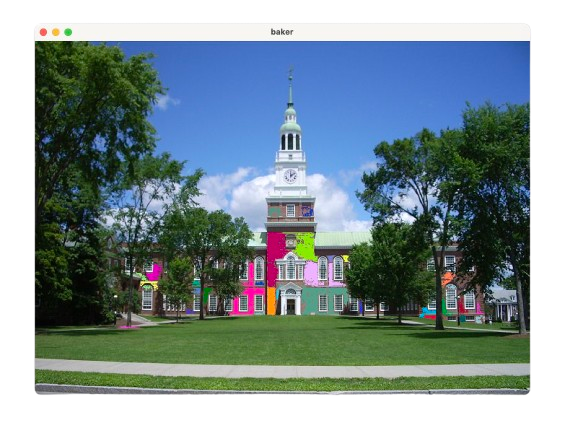
Flood-fill region detection on Baker Library. Regions of roughly brick-colored pixels are recolored at random, so each color block is one connected component the region grower found. Point Quadtrees for Spatial Search and Collision Detection
Implemented a point quadtree (a 2D index that generalizes a BST to four-way partitioning) with log-time insertion and circular range queries. Each node subdivides its bounding rectangle into four quadrants, pruning subtrees whose rectangles don't intersect the query circle.
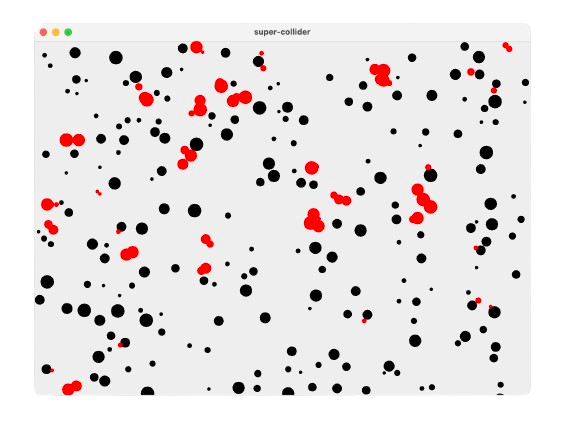
Point quadtree with quadrant boundaries drawn as colored rectangles. 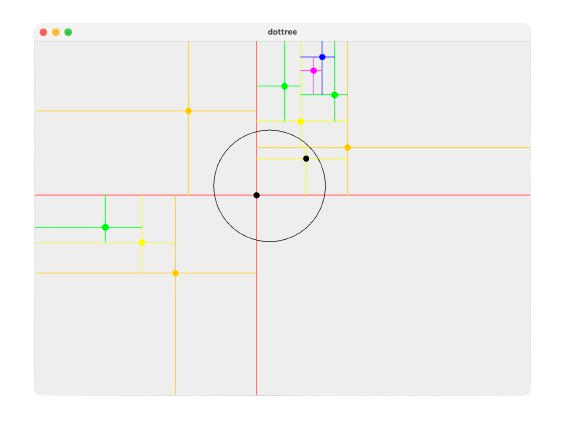
Collision detection via quadtree-accelerated proximity search. Huffman Encoding for Lossless File Compression
Built the full Huffman pipeline: character frequency analysis, priority-queue construction of an optimal prefix-free code tree, a single traversal to generate the code map, and bitwise file I/O for compression and decompression. Greedily merging the two lowest-frequency subtrees guarantees minimum expected codeword length; decompression walks the tree bit-by-bit, emitting a character at each leaf. Handles edge cases (empty files, single-character alphabets) and round-trips losslessly on the US Constitution and War and Peace.
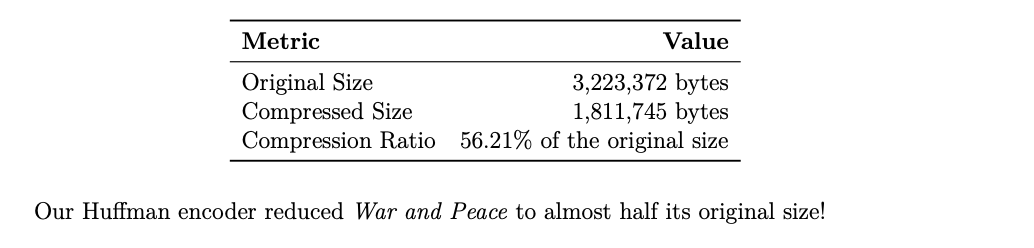
Compression results on Tolstoy's War and Peace. The Huffman encoder cut the file to about half its size, reflecting the entropy gap between fixed-width ASCII and prefix-free codes tuned to the text's character distribution. Kevin Bacon Game / Graph-Based Social Network Analysis
Built a social network analysis engine over a costar graph (9,235 actors, 32,337 edges), using BFS to build shortest-path trees from any chosen center of the universe. The graph library is fully generic over vertex and edge types, with edges labeled by shared movies, and supports path reconstruction, disconnected-component detection, and recursive average separation without enumerating all paths. Added degree, betweenness, closeness, and eigenvector centrality across the full graph. Built a second game, Degrees of Friendship, on the Stanford SNAP Facebook Ego Network (4,039 users, 88,234 edges), with random-walk reachability as a scalable alternative to full BFS. Exported the acting universe to GEXF for Gephi.
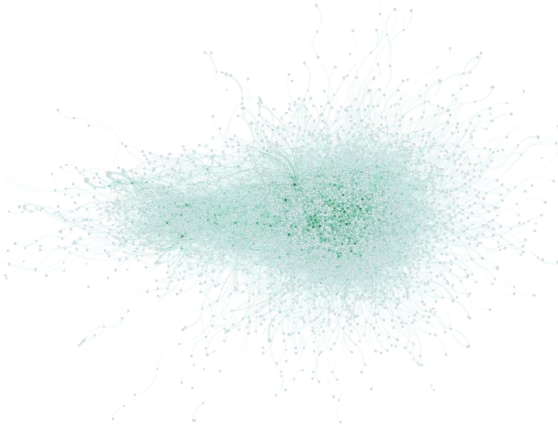
Gephi force-directed layout of the full costar graph. Node darkness encodes degree centrality, so the dense core is the high-connectivity actors (Kevin Bacon, Gene Hackman, Robert De Niro) and the long-edged periphery is actors reachable only through longer paths. Exported with a custom GEXF serializer. Part-of-Speech Tagging via Hidden Markov Models and Viterbi Decoding
Trained a bigram hidden Markov model on the Brown corpus (579,662 tokens), learning log-probability transition (tag-to-tag) and emission (tag-to-word) distributions. Implemented Viterbi for MAP inference over tag sequences: at each word it scores every candidate next-state by its predecessor's score plus the transition and emission log-probabilities, keeping the best predecessor via backpointers. Reached 96.38% accuracy on the test set (35,077 correct, 1,317 wrong). A sensitivity analysis on the unseen-word penalty showed accuracy stays stable from -100 to -10, drops at -5 (93.91%), and collapses at -1 (0.03%), where unseen scores rival observed ones and Viterbi picks implausible paths.
Collaborative Graphical Editor (Multithreaded Client-Server Architecture)
Designed a real-time collaborative drawing app on a client-server architecture with a centralized sketch model. Multiple Editor clients connect to a SketchServer over TCP; drawing actions are sent as string-encoded requests, and the server broadcasts updates to all clients, including late joiners who get the full sketch on connection. Shapes (ellipses, rectangles, segments, freehand polylines) are tracked by unique IDs in a synchronized TreeMap, and synchronized methods in the Sketch class lock state during mutation so only one thread edits at a time.
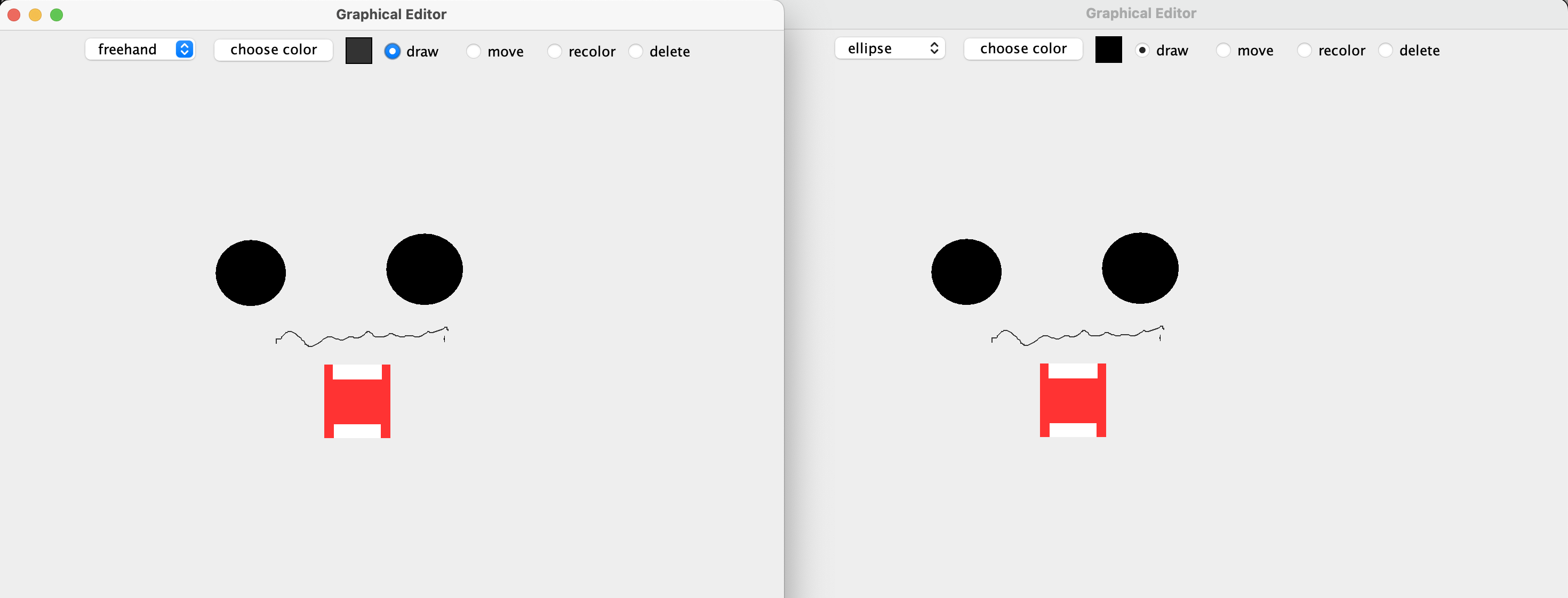
Two Editor clients connected to the same SketchServer, each showing the same sketch (ellipses, freehand polyline, rectangle). Received a Citation for Meritorious Performance. From Prof. Alberto Quattrini Li’s official statement:
“Unwavering commitment to learning in the class by ensuring high-quality coursework!”
— Prof. Alberto Quattrini LiThe class began with the human factors stack (perception, motor control via Fitts' Law, cognition and memory under information processing and cognitive load frameworks, decision-making) and then built outward into the design and evaluation of systems that respect these constraints. Research methods that we studied spanned quantitative (factorial designs, hypothesis testing, causal inference), qualitative (ethnography, interviews, observational studies), and computational approaches (NLP for HCI, large-scale behavioral analysis, network methods). We also learned more about information visualization (graphical inference, uncertainty representation), computational interaction (optimization-driven interface design, adaptive UIs via ML), human-AI interaction (trust calibration, explainability, mixed-initiative systems), and CSCW (crowd computing, group dynamics in digital environments).
Received a Citation for Meritorious Performance. From Prof. Nikhil Singh’s official statement:
“Rahee was 1 of 3 who earned the highest overall score in a class of 87. Her final project was the strongest one in the course even over many PhD student projects. She consistently produced excellent work that was precise and methodical.”
— Prof. Nikhil SinghA full-stack web development class covering modern web applications end to end: static pages and markup, Internet protocols, event-driven asynchronous programming, deployment, security, and scalability. We built complete applications with both client and server components, from front-end UI to server-side API design and real-time communication.
Received a Citation for Academic Excellence.
A graduate seminar on the design, theory, and evaluation of AI agents as intermediaries between human intent and computational action. It was organized around this question: when should we delegate tasks to autonomous systems, and what do we lose (or gain) in the transfer of control? The class approached this question historically, beginning with the Maes-Shneiderman debate on direct manipulation vs. interface agents (IUI/CHI 97) through Horvitz's mixed-initiative principles and into Russell and Norvig's formal agent framework. We then turned to modern LLM-driven agents, working through the ReAct paradigm for synergizing reasoning and acting (Yao et al. 2022), generative agent simulations of human behavior (Park et al. 2023), and cognitive architectures for language agents (Sumers, Shao et al. 2024), looking closely at what autoregressive training actually buys you (McCoy et al. 2023) and where larger models become less reliable (Zhou et al. 2024).
We also studied the Economic perspectives like principal-agent theory (Ross 1973, Stiglitz 2016), delegated search as an approximation of efficient search (Kleinberg and Kleinberg 2018), and contract-based orchestration of RL agents (Ivanov et al. 2024). The alignment and trust readings covered cooperative inverse reinforcement learning (Hadfield-Menell et al. 2016), governance frameworks for AI agents (Kolt 2025), and justified trust as a function of competence and alignment (Manzini et al. 2024). My presentation addressed world models (Friston et al. 2021, Li et al. 2023), multi-agent debate for improving factuality (Du et al. 2023), and applications spanning scientific discovery, programming (SWE-bench), web interaction, and computational art.
Received a Citation for Meritorious Performance. From Prof. Nikhil Singh’s official statement:
“Rahee did great work this term, with an unusually original and well-executed final project that I believe could be publishable. She stood out in a course populated largely by graduate students, with some of the highest quality work submitted throughout.”
— Prof. Nikhil Singh
Other
I took COLT 1, “Read the World,” during my freshman fall, and reading we did. The course introduced us to comparative methods for confronting the misunderstandings and mistranslations that shape reading across the world’s languages, locations, cultures, historical periods, and expressive forms. We examined foundational texts from multiple traditions alongside contemporary critical theory and methods of close reading. It was my first introduction to Jorge Luis Borges, Benedict Anderson, Michel Foucault, and several other thinkers who changed how I understand culture, language, and interpretation. I really enjoyed how wide-ranging the class was. We read about literature, anthropology, translation theory, media, film, museum objects, video games, surveillance, AI and data bias, and liberal arts knowledge systems.
ECON 1 focused on supply and demand in product and factor markets, with applications to resource use, the distribution of income and output, and public policy. We also explored topics such as industrial organization, antitrust policy, labor economics, international trade, economic development, agriculture, urban problems, poverty and discrimination, public-sector economics, and environmental issues.
Because I had participated in the national camp for the International Economics Olympiad, I had already self-studied much of this material. Even so, learning it in a Dartmouth classroom with Professor Diego Ramos Toro was really fun, especially because the course connected familiar economic models to broader questions about policy, markets, and society.
I took WRIT 5, “Ethics of the Internet,” with Professor Chris Drain as my first-year expository writing course at Dartmouth. The class examined the ethical and political problems created by ubiquitous computing, using texts from philosophy, political theory, sociology, and contemporary tech journalism.
We studied platform and surveillance capitalism, algorithmic harms, digital surveillance, disinformation, echo chambers, online speech, trolling, social media bans, and First Amendment debates. We also studied questions about technological mediation (how design shapes agency, how technical artifacts can carry political values, and whether technology can ever be morally neutral).
This course became one of the earliest places where my interests in writing, ethics, and artificial intelligence began to meet. Reading thinkers like Shoshana Zuboff and writing about epistemic bubbles, AI, accents, apology, and online identity made me see the internet as a moral infrastructure, which is shaped by incentives, interfaces, and power. My final essay, “Accents, Apologies, and AI,” was nominated by Professor Drain for Dartmouth’s Dickerson/Feinstein first-year writing prize, and the class partly motivated my later interest in the AI alignment problem.
It was a course on women as subjects, creators, and critics of art and society in China, Korea, and Japan from the sixteenth century to the present.
We began with feminist art history, including Linda Nochlin’s “Why Have There Been No Great Women Artists?,” and then read about depictions of exemplary women in traditional Chinese, Korean, and Japanese art. I learned to look across many forms of visual culture, from literati painting and court painting to beauty prints, modern posters, photography, performance, installation, and contemporary media art. It was interesting how the images of women were never neutral. If you looked hard enough, you’d see the ideals of virtue, beauty, labor, sexuality, nationalism, memory, and power.
What I loved most was how much history I learned through art that term. While studying visual culture, we also traced major political and social transformations across East Asia: the Edo period and the fall of the Tokugawa shogunate, the Meiji Restoration, imperial China, the Opium Wars, the Cultural Revolution, and the figure of the “iron girl” in Mao-era China. In Korea, we studied the effects of Japanese colonial rule, the postwar period, the Park Chung-hee era, and the later rise of Hallyu, the global spread of South Korean popular culture.
The second half of the course moved into modern and contemporary women artists in East Asia. We studied the “modern girl” in China, Korea, and Japan, women’s artistic labor, body politics, psychoanalysis, diaspora, nomadism, new media, and feminist artistic experimentation.
† Awarded Citations for meritorious performance.
Part II
Clubs & Organizations
Dartmouth Women in Computer Science (WiCS)
Recruiting Chair
Coordinate technical preparation events, interview hackathons, resume workshops, and research panels with faculty and industry professionals.
Great Issues Scholar
The John Sloan Dickey Center for International Understanding at Dartmouth
An interdisciplinary program where we examined global policy and security.
Society for Industrial and Applied Mathematics
Dartmouth Chapter
Association for Women in Mathematics
Dartmouth Chapter
For the love of lemmas.
Dartmouth Quantitative Finance
Dartmouth Tech Consulting Group
